Every child, regardless of ability, deserves a life filled with hope, love, and opportunity. Yet for children with autism in Nepal, these basic rights often remain out of reach. Autism is a lifelong developmental condition that affects how people communicate, interact, and experience the world. In a country where awareness and resources remain limited, families of children with autism often face their journey alone under-supported, misunderstood, and marginalized.
But there’s hope and it starts with you.
AutismCare Nepal Society (ACNS), Nepal’s first and only autism-focused non-governmental organization led by parents, has been changing this narrative since 2008. Through compassionate care, educational innovation, and a deep commitment to inclusion, ACNS empowers children with autism and their families to live with dignity and potential.
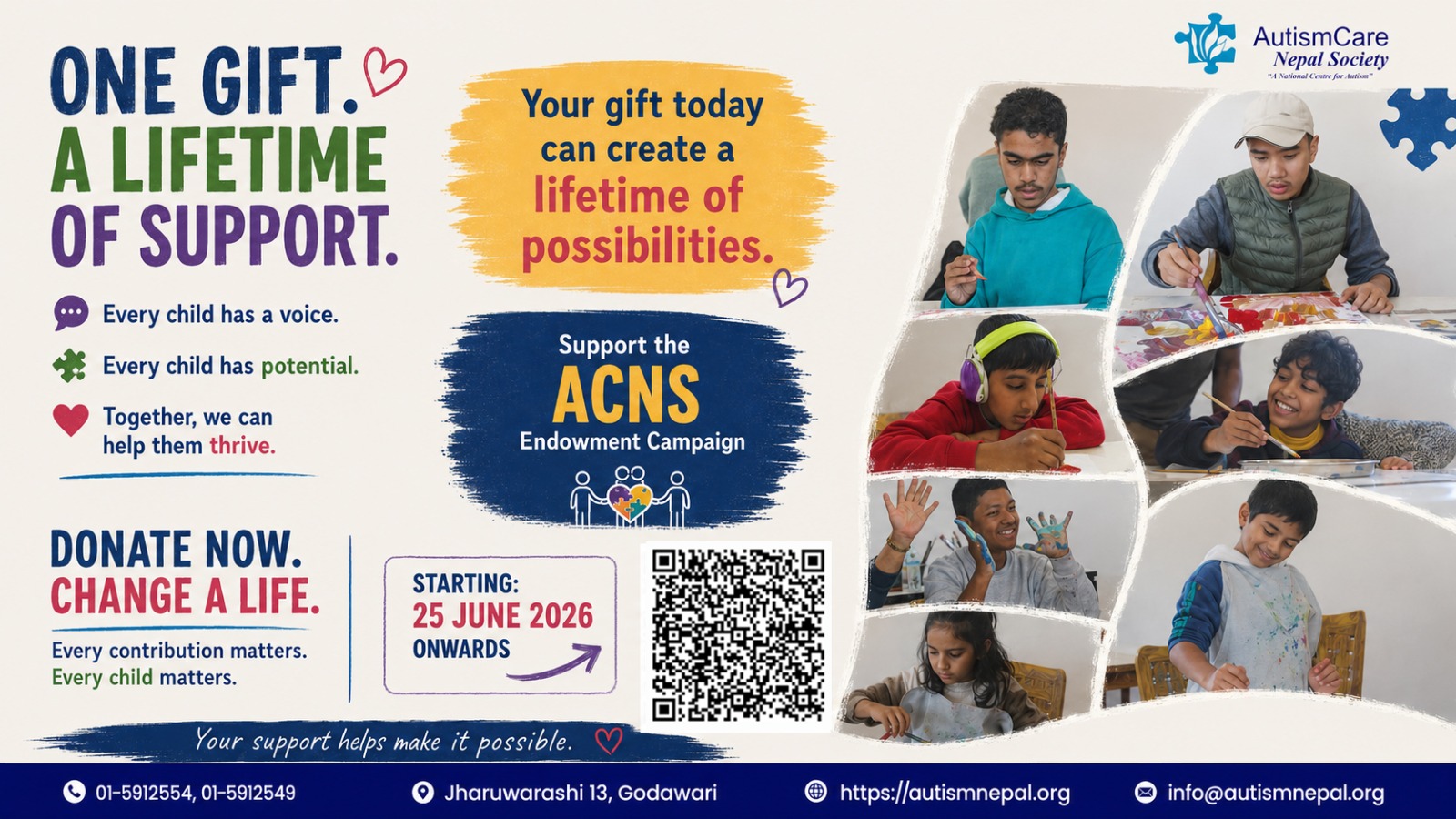
Your contribution, no matter how small, can help fund critical services like therapy, education, transportation, and advocacy programs that literally change lives.
Give a little, help a lot. Because when you support a child with autism, you’re not just giving charity you’re investing in possibility.
About AutismCare Nepal Society
Established on World Autism Awareness Day, April 2, 2008, AutismCare Nepal Society is a pioneering force in the autism movement in Nepal. What makes ACNS truly unique is that it was founded and continues to be led by parents of children with autism. This personal connection has shaped a deeply empathetic, community-centered approach to care and advocacy.
Registered under the Social Welfare Council, ACNS works with hundreds of children, parents, educators, and volunteers across the country every year. Its holistic services span diagnosis, therapy, education, parent training, and policy advocacy with the ultimate goal of building an inclusive, autism-friendly Nepal.
Here’s what sets ACNS apart:
- Multidisciplinary Services: Combining behavioral therapy, speech-language therapy, occupational therapy, and special education in one comprehensive center.
- Education & Training: From Aarambha (pre-primary school) to vocational programs, ACNS fosters learning at every age.
- Policy Advocacy: ACNS works with government ministries and international partners to improve national autism policies and infrastructure.
- Parent Empowerment: Equipping caregivers with the tools and training to support their children long-term.
ACNS doesn’t just provide services it creates hope. And that hope is funded by people like you.
Why Your Help Matters
Imagine being a parent in rural Nepal, watching your child struggle with communication, behavior, and daily routines yet having no idea why. Imagine finally learning the word autism, only to realize that support is scarce, expensive, and mostly centered in Kathmandu. This is the reality for thousands of families in Nepal today.
Children with autism need early intervention, regular therapy, educational opportunities, and a supportive environment. But these services are often inaccessible to low-income families. Government support is limited. Public awareness is still evolving. And stigma remains a heavy barrier.
Your contribution to AutismCare Nepal Society directly addresses these gaps. Donations support children who:
- Cannot afford therapy or school supplies
- Live too far to access school without transport
- Need intensive care but lack insurance or government support
- Are gifted in arts or music but need inclusive platforms to shine
When you give, you’re not just helping an organization. You’re lifting the burden from a family. You’re giving a child the chance to go to school, to speak their first words, to express themselves through art or movement. You’re telling parents they’re not alone and that someone cares.
Together, we can rewrite the story of autism in Nepal. All it takes is a little help.
Major Projects You Support: Building a Brighter Future
When you support AutismCare Nepal Society (ACNS), you directly fund vital projects that serve some of Nepal’s most vulnerable children. Each program is carefully designed to address a critical barrier faced by families living with autism. Let’s take a closer look at how your contribution makes a real difference.
1. Sahara Fund – Lifting the Financial Burden
Many families in Nepal face heartbreaking decisions: Should they pay for therapy for their child, or buy groceries for the week? The Sahara Fund exists to remove that impossible choice.
This need-based support program helps families who cannot afford therapy, special education, or even the transportation required to bring their children to ACNS facilities. Every rupee donated to this fund ensures a child receives the care they deserve regardless of their socioeconomic background.
Your impact:
- Pays for therapy sessions for low-income children
- Provides educational materials and supplies
- Offers uniforms, meals, and support for families in crisis
“Without the Sahara Fund, my son would have dropped out of therapy. Now he’s learning to speak,” says one grateful parent.
2. Intangible Support – Awareness & Advocacy Programs
Awareness is the first step toward acceptance. In Nepal, misconceptions and stigma still surround autism, often leading to isolation or discrimination. That’s why ACNS invests heavily in awareness and advocacy efforts.
These programs include:
- Public awareness campaigns on social media and local radio
- Autism awareness rallies and educational workshops
- Policy dialogues with government officials and lawmakers
- Parent training and peer support groups
This work doesn’t just educate it transforms mindsets, building a more inclusive and compassionate society for children with autism.
Your impact:
- Reaches thousands of citizens through outreach campaigns
- Trains parents to become advocates and educators in their communities
- Pushes for better government funding and autism-friendly policies
3. Educational Support – Learning Beyond Limits
Children with autism learn differently but that doesn’t mean they can’t learn. ACNS provides inclusive, personalized education through its Aarambha School (pre-primary level) and additional programs.
Through structured teaching, arts-based learning, and sensory-integrated environments, children with autism are empowered to build communication, academic, and social skills.
Educational support also includes:
- Arts and music therapy
- Sports programs for physical and social development
- Access to technology-based learning tools
- School supplies and uniforms
Your impact:
- Funds classrooms, materials, and special educators
- Supports creative outlets that allow children to express themselves
- Encourages self-esteem, focus, and teamwork
4. School Bus Support – Bridging the Distance
In a country like Nepal, transportation is a huge challenge especially for families living far from specialized services. ACNS operates a dedicated school bus service to ensure that children can reach the center safely and on time.
This service covers areas where public transportation is not autism-friendly or simply unavailable.
Your impact:
- Covers daily fuel and maintenance costs
- Helps ACNS expand transport services to underserved areas
- Ensures continuity in therapy and education for dozens of children
Without reliable transportation, even the best therapy goes unused. Your donation literally keeps the wheels turning.
5. Scholarships – Empowering the Future
Some children show exceptional promise in art, music, technology, or communication but need sustained support to reach their full potential. ACNS offers scholarships for students who demonstrate talent, commitment, and financial need.
These scholarships help pay for:
- Ongoing education and therapy
- Participation in inclusive events and competitions
- Specialized training and learning opportunities
Your impact:
- Funds tuition, therapy, or extracurricular costs
- Encourages children to pursue their interests and talents
- Builds confidence and long-term opportunity
6. Therapeutic Support – Building Life Skills
At the heart of ACNS’s mission is therapy the foundation for progress in communication, behavior, and daily living skills. The center offers a multi-disciplinary model that includes:
- Speech-language therapy
- Occupational therapy
- Behavioral intervention (ABA)
- Sensory integration therapy
- Group and play therapy
Therapists work one-on-one and in small groups to meet each child’s individual goals, whether it’s learning to brush their teeth, make eye contact, or express a need using pictures or words.
Your impact:
- Covers the cost of hiring and training therapists
- Buys therapy tools, sensory toys, and assistive technology
- Gives children the tools to live more independently
Together, these projects form a powerful network of care, support, and opportunity but they can’t run on compassion alone. They need sustained financial backing, and that’s where your generosity changes everything.
Every donation you make supports a real child, a real family, and a real future.
Real Impact Stories: Hope in Action
“Ravi’s(name changed) First Words”
At four years old, Ravi(name changed) had never spoken a word. His parents, day laborers in Bhaktapur, had tried everything they could within their limited means but without access to therapy, Ravi(name changed) remained locked in silence. When they brought him to AutismCare Nepal Society, they were given not just an assessment, but hope.
Through daily speech-language sessions and parent coaching supported by the Sahara Fund, Ravi(name changed) began to form sounds, then syllables and finally, his first word: “Aama.” (Mother). Today, Ravi(name changed) continues to grow in ACNS’s pre-primary classroom, where he receives both therapy and early education.
“Mina’s(name changed) Journey to Confidence”
Mina(name changed), a bright 9-year-old girl on the autism spectrum, loved drawing but struggled with social interaction and sensory sensitivities. With help from ACNS’s educational support and arts therapy programs, she now confidently shares her artwork in class. Her teachers have noticed improvements in her communication and self-esteem.
Last year, she even represented her class at an inclusive art event in Kathmandu her first public performance ever.
These stories are just two among hundreds. Every child is unique, but all share the same need: support, understanding, and opportunity. That’s what your contribution makes possible.
How to Contribute: Make a Difference Today
Making an impact is easier than you think. Whether you’re donating ₹100 or ₹10,000, every contribution fuels life-changing programs at AutismCare Nepal Society.
Ways to Contribute:
- Scan the QR Code on our flyers or website to donate digitally
- Bank transfer or in-person donation via our registered office in Kathmandu
- Monthly giving to support therapy or education long-term
- In-kind support such as books, art supplies, or technology
- Corporate partnerships and CSR collaborations
Want to do more? You can also:
- Volunteer your time and skills
- Help us spread awareness on social media
- Sponsor a child’s education or therapy directly
Email: info@autismnepal.org
Phone: 01-5912554 / 01-5912549
Website: www.autismnepal.org
Even the smallest act of kindness creates a ripple.
Why Support Now?
The need has never been greater.
Autism is being identified more often in Nepal, but services haven’t kept pace. Many districts still have no therapy centers, no trained teachers, and no support systems. The economic impact of raising a child with autism can be overwhelming especially for single parents or low-income households.
Your timely support helps:
- Expand services to more children and districts
- Train more therapists and special educators
- Reduce waiting lists for therapy
- Fund awareness campaigns to fight stigma
Inclusion is not a luxury. It’s a right. And with your help, ACNS can continue building a more accessible, understanding, and hopeful Nepal one child at a time.
Support today, transform tomorrow.
Conclusion & Call to Action
AutismCare Nepal Society is more than an organization it’s a lifeline for families, a champion for inclusion, and a source of hope for hundreds of children.
Your generosity fuels everything we do.
Give a little, help a lot. Because for a child with autism, your donation isn’t just money it’s therapy, education, confidence, and a chance at a full life.
Let’s build an inclusive Nepal together.
Donate now, share this message, or get involved.
Because your compassion has the power to transform lives.
Building Bridges: How Parents and Teachers Shape Inclusive Education
Inclusive education isn’t just a model it’s a movement. It’s a philosophy that every child, regardless of their ability, deserves the opportunity to learn, grow, and thrive in a shared learning environment. For children with autism and other developmental disabilities, inclusive education can be the gateway to participation, dignity, and a fulfilling life. But inclusive education doesn’t happen in isolation. It is shaped and strengthened by two key pillars: parents and teachers.
In Nepal, AutismCare Nepal Society (ACNS) is leading the charge in inclusive education. As the country’s only parent-led national organization focusing on autism, ACNS plays a transformative role in building bridges between families and schools. This blog explores how parents and teachers empowered and supported by organizations like ACNS can co-create inclusive environments that support every learner.
What Is Inclusive Education?
Inclusive education means that all students, regardless of their physical, intellectual, social, emotional, linguistic, or other conditions, are taught in the same classrooms. Rather than isolating children with disabilities, inclusive education integrates them into mainstream settings while providing necessary support to ensure they thrive.
In Nepal, where awareness about autism and developmental disorders is still emerging, inclusive education also involves challenging long-standing stigmas and creating a more compassionate and adaptive learning ecosystem. For children with autism, inclusion isn’t just about being present in a classroom it’s about being understood, respected, and supported.
The Vital Role of Parents
Parents are a child’s first educators, advocates, and protectors. In the realm of inclusive education, their role is irreplaceable.
Advocates for Inclusion
Parents are often the first to recognize their child’s unique needs and potential. At ACNS, many parents play an active role in raising awareness about autism, advocating for inclusive school policies, and lobbying for disability-friendly budgets and policies. Their voices are instrumental in challenging misconceptions and building a more accepting society.
Empowering Through Training
ACNS offers regular parent-child training sessions, where caregivers learn techniques like Applied Behavior Analysis (ABA), TEACCH (Treatment and Education of children with autism and related Communication-handicapped Children), and Verbal Behavior Analysis. These tools equip parents to support learning both at home and in collaboration with teachers.
Building a Community
Parents often feel isolated when raising children with special needs. ACNS fosters a strong parent support network, creating safe spaces for sharing, learning, and collective action. The organization’s parent-led approach ensures that families don’t feel alone in their journey they are part of a movement.
Teachers: The Cornerstone of Inclusion
Teachers are at the frontline of inclusive education. Their attitudes, training, and daily practices determine whether inclusion is meaningful or merely symbolic.
Training for Transformation
One of ACNS’s landmark contributions is its Diploma in Special Education for Autism Spectrum Disorder (ASD). This program trains teachers in inclusive teaching strategies, behavior management, sensory integration, and the development of Individualized Education Programs (IEPs).
Through these trainings, teachers learn to adapt lesson plans, classroom environments, and communication methods to meet the needs of diverse learners.
Creating Supportive Classrooms
Inclusive teaching isn’t about treating every student the same it’s about responding to their individual needs. Teachers trained through ACNS learn to:
- Use visual aids and structured routines
- Incorporate sensory tools
- Build social and communication skills
- Set achievable goals through IEPs
These strategies ensure that children with autism can participate fully in classroom life, improving both academic outcomes and social integration.
Parent-Teacher Collaboration: A Powerful Partnership
For inclusive education to work, parents and teachers must work together sharing knowledge, aligning strategies, and building trust.
Shared Understanding
When parents and teachers maintain open communication, they can provide consistent reinforcement of skills at home and school. For example, if a teacher observes a student struggling with transitions, the parent can implement similar visual cues at home.
Real Stories from ACNS
In ACNS’s Aarambha Pre-Primary School and Aakaar Vocational Unit, collaboration is a daily practice. Teachers provide regular updates to parents, and parents contribute by sharing home observations. This feedback loop helps tailor IEPs more effectively and encourages mutual respect.
One parent shared, “When my son began showing signs of progress at school, it was because his teacher and I were finally in sync following the same strategies, speaking the same language of care.”
Challenges in the Nepali Context
Despite these inspiring efforts, challenges remain particularly in rural Nepal.
Barriers to Inclusion
- Limited Resources: Many schools lack trained personnel and accessible infrastructure.
- Cultural Stigma: Autism and disabilities are still misunderstood and stigmatized in many communities.
- Policy Gaps: Government support for inclusive education is limited and inconsistent.
ACNS’s Interventions
- Professional Development for educators ensures rural schools aren’t left behind.
- Advocacy Work promotes better inclusion in national education policies.
Action Steps: How Parents and Teachers Can Lead
Inclusive education is a shared journey. Here’s how parents and teachers can make it thrive:
For Parents:
- Attend training programs and support groups.
- Communicate openly with teachers.
- Advocate for your child’s rights in school settings.
For Teachers:
- Pursue professional development in special education.
- Be flexible and creative with teaching strategies.
- Involve parents as equal partners.
For Both:
- Celebrate small victories and progress.
- Focus on building the child’s confidence and independence.
- Foster a learning environment based on empathy and respect.
Conclusion: Building Bridges for a Better Tomorrow
Inclusive education is not the responsibility of a single teacher or parent it is a shared commitment to equity, dignity, and opportunity. At the heart of this movement are organizations like AutismCare Nepal Society, empowering families and educators to collaborate, learn, and lead change.
By working hand in hand, parents and teachers are not just building better classrooms they are shaping a more inclusive society.
Want to Learn More or Get Involved?
Visit autismnepal.org to explore how you can:
- Join a training or workshop
- Volunteer with ACNS
- Support autism inclusion in Nepal
Together, let’s build bridges not barriers for every learner.